


Having 24-hour availability ensures that individuals can receive assistance, information at any time.
Serious cases of Patients with life-threatening injuries or illnesses are given immediate attention.
Hospitality in healthcare involves tailoring medical services to the individual needs and preferences of the patient.
Jaslok Hospital’s internationally trained team of experienced orthopaedic surgeons, joint replacement specialists, physiotherapists, and rehabilitation experts provides comprehensive care for patients suffering from knee problems. The team specialises in advanced knee replacement procedures, including Total Knee Replacement, Partial Knee Replacement, Robotic-Assisted Knee Replacement, and complex revision knee replacement surgeries, helping patients regain mobility and improve their quality of life.
Kinematic Robotic Knee Replacement — In Simple Words Normally, when a knee is replaced, doctors try to make everyone’s leg perfectly straight — like a standard, one-size-fits-all alignment.Kinematic replacement does the opposite. It tries to put your new knee back exactly where your original knee was.Think of it like this: Your knee was not perfectly straight when you were born. It had its own natural angle, its own way of bending. Kinematic surgery respects that.What the robot and surgeon do:They study your knee’s original shape and movementThey remove only as much bone as needed — exactly the thickness of the new implant, no moreThey clear out the extra bone spurs that were blocking your movementThey place the new knee parts to match your natural alignment, not a textbook alignmentWhy does this matter?Because your ligaments and soft tissues are not cut or stretched to fit a new alignment. They are left as they are.So after surgery, your knee:Bends more naturallyFeels more like your knee, not an artificial oneMoves smoothly, without that stiff, robotic feelingIn short — Instead of changing your knee to fit the implant, we fit the implant to your knee.

Director, Orthopaedics & Robotic Knee Replacement Surgery
Years of experience: 30+ years
Medical Qualification: MBBS, MS (Orthopaedics), M Med Sc Surgery of Trauma (Birmingham, UK), AO Fellow (Germany), D. Sports Medicine (Royal Colleges, UK), MCh Orthopaedics (Liverpool, UK), FRCS Trauma & Orthopaedics (Royal Colleges, UK), Hip & Knee Replacement Fellowships (USA)
Experienced specialists assess each patient's condition and treatment options.
Access to kinematic robotic-assisted surgical technology and modern diagnostic capabilities.
Anaesthesia, imaging, physiotherapy, nursing and other supporting specialties work together.
Treatment planning is based on individual anatomy, medical history and functional goals.
Specialised Robotic-Assisted and Aquatic Therapy, along with Conventional Therapy.
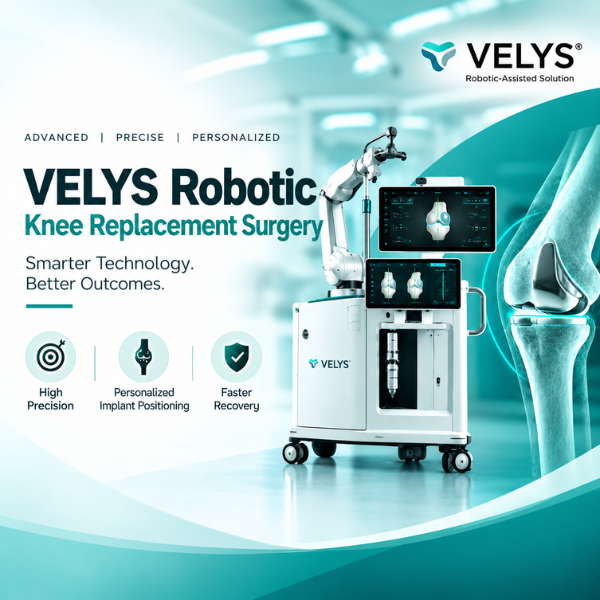
Robotic knee replacement is an advanced surgical approach that uses computer-assisted
planning and robotic technology to assist the surgeon in performing knee replacement with
greater precision.
No. The surgery is performed by an orthopaedic surgeon. The robotic system assists the
surgeon with planning and precise execution during the procedure.
Robotic-assisted surgery offers advanced surgical planning and technology-assisted precision. Whether it is the right option depends on your individual condition and your surgeon’s clinical assessment.
Patients with severe knee arthritis, persistent pain, joint damage or difficulty with daily
activities may be candidates. Your orthopaedic specialist will determine if it is suitable for
you.
Your knee is evaluated using clinical assessment and imaging to create a personalised
surgical plan based on your individual anatomy.
Knee replacement surgery generally takes around 1–2 hours, depending on the complexity of the procedure and the patient’s individual condition.
Most patients may stay in the hospital for a few days, depending on their recovery, mobility
and overall health.
Patients are generally encouraged to begin mobilisation soon after surgery, with support from
the medical and physiotherapy team.
Recovery varies from person to person. Many patients gradually return to normal activities
over several weeks, with continued improvement over the following months.
The cost varies based on the implant, surgical requirements, hospital stay and other individual
factors. A personalised estimate can be provided after consultation.
Insurance coverage depends on your policy and insurer. Our insurance/TPA team can help
you understand your coverage and eligibility.
Bring your previous medical records, X-rays/MRI scans, test reports, medication list and
details of any previous knee treatments or surgeries.